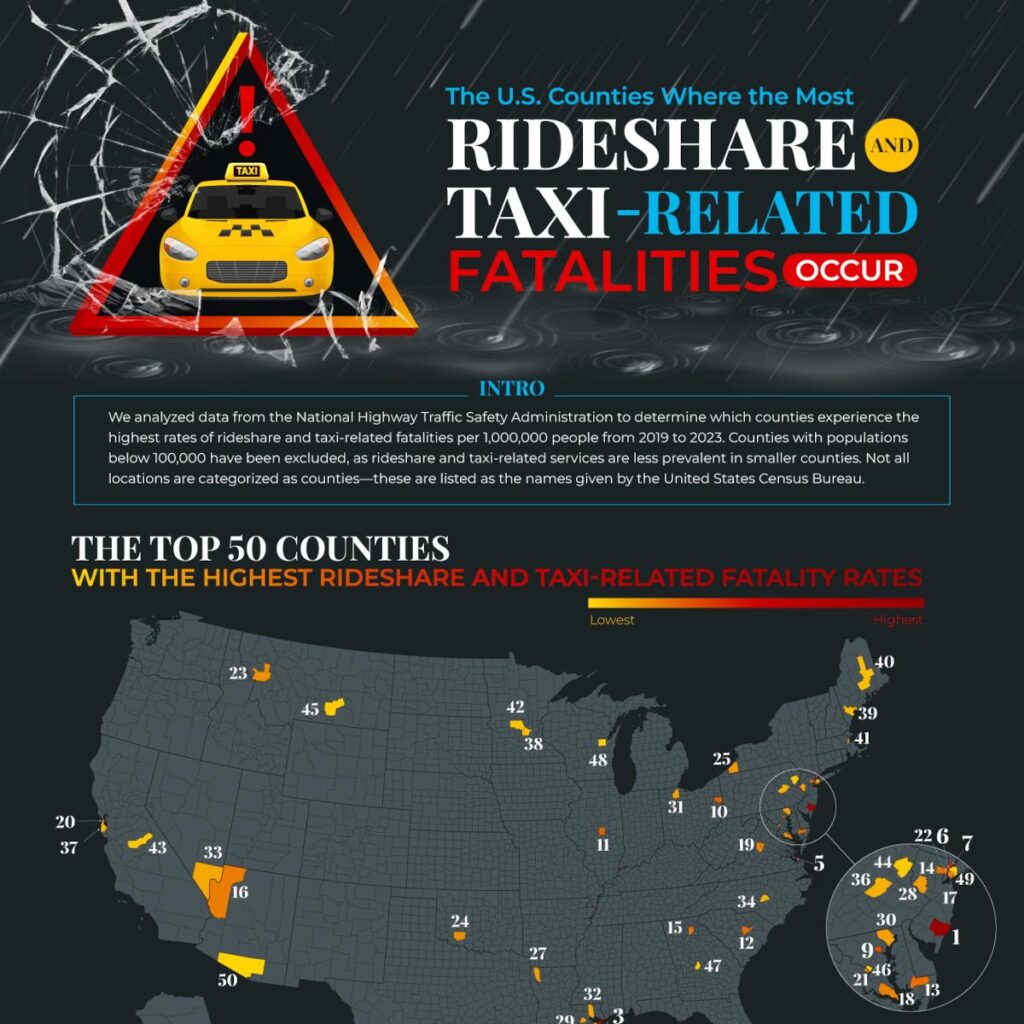
In the modern era, the evolution of transportation has introduced both new conveniences and significant infrastructure challenges. While app-based services and traditional taxis are a staple of daily life, they have contributed to complex safety issues on our roads. At Blume Forte Attorneys at Law, we analyzed data from the National Highway Traffic Safety Administration (NHTSA) to identify the specific locations where these risks are most acute.
Our study, titled The U.S. Counties Where the Most Rideshare and Taxi-Related Fatalities Occur, looks at fatality rates per 1,000,000 people between 2019 and 2023. This data provides a necessary look at the safety trends affecting drivers and pedestrians across the country, with a particular focus on the unique challenges faced here in New Jersey.
New Jersey Road Safety: A Concerning Trend
The data regarding New Jersey’s roadways serves as a sobering reminder of the work still needed to protect our communities. According to our findings, traffic fatalities in the state increased by 14% between 2023 and 2024. Even more alarming is the 32% rise in pedestrian fatalities during that same timeframe.
The reasons for these increases are often tied to the changing nature of our transit infrastructure. Research from Rutgers University indicates that Transportation Network Companies (TNCs), such as Uber and Lyft, have contributed to landslide congestion at airport facilities. This overcrowding exacerbates high-stress environments, particularly at arrival and departure points. Factors that compromise safety in these areas include:
- Narrow lanes that leave little room for error.
- Confusing signage that can distract even experienced drivers.
- High-pressure environments for both drivers and passengers.
High-Risk Counties in New Jersey
Our analysis of counties with populations above 100,000 reveals that New Jersey holds several of the top spots for rideshare and taxi-related fatalities nationwide.
Atlantic County: National Leader in Fatality Rates
Atlantic County, home to Atlantic City, ranks as the #1 county in the United States for the highest rideshare and taxi-related fatality rate. With a rate of 21.67 per 1,000,000 people, it represents the highest level of risk identified in our study. The constant flow of visitors and the heavy reliance on hired transportation in this region create a unique set of hazards.
Essex and Hudson Counties: High Fatality Totals
The urban centers of North Jersey also appear prominently in the national rankings:
- Essex County: Home to Newark, this county ranks 14th for the highest fatality rate per 1,000,000 people and 10th for total deaths overall. Between 2019 and 2023, there were 8 total fatalities recorded.
- Hudson County: Including Jersey City, this county ranks 22nd in the nation with 6 total deaths.
- Hunterdon County: Also featured in the top 25 with a fatality rate of 7.66.
National Fatality Rankings
While New Jersey figures prominently, our study identified high-risk counties across the United States. New York County (Manhattan) and Kings County (Brooklyn) recorded some of the highest total fatality numbers, with 22 and 23 deaths respectively. Other areas with high fatality rates include Anchorage Municipality in Alaska and Orleans Parish in Louisiana. These rankings highlight that the risks associated with rideshare and taxi services are a widespread national concern.
The Personal Safety Risk: Misconduct Reports
The danger in these services extends beyond traffic accidents. Our analysis notes that between 2017 and 2022, Uber received 400,181 reports of sexual assault or misconduct in the United States. This averages out to one incident every eight minutes. While millions of rides are completed successfully, these figures demonstrate that more effort is needed to protect passengers from harm that occurs inside the vehicle.
Efforts Toward Improvement: Target Zero Commission
Despite these statistics, there are proactive steps being taken to improve the safety of New Jersey’s roads. In January 2025, Governor Phil Murphy signed legislation creating the Target Zero Commission. This multi-department initiative is designed to eliminate traffic deaths and serious injuries across the state by 2040. At Blume Forte Attorneys at Law, we view every avoided injury and saved life as a victory for the people of New Jersey.
Practical Safety Tips for Rideshare and Taxi Passengers
While the responsibility for safety lies largely with the transportation companies and their drivers, passengers can take steps to protect themselves. Recommended steps for staying safe during a ride include:
- Always verifying the driver and vehicle details before entering.
- Staying alert to your surroundings during the journey.
- Using available safety features within rideshare apps to share your trip status.
The Role of Blume Forte Attorneys at Law
Since 1929, the attorneys at Blume Forte Attorneys at Law have been dedicated to advocating for those who have been wronged or injured. The statistics in our study reflect broader trends that we see in our practice every day. We understand the physical, emotional, and legal toll that a serious accident takes on a family.
Whether an injury is the result of a traffic collision in a high-congestion area like an airport or involves a report of misconduct, our personal injury firm remains committed to holding negligent parties accountable. Navigating the legal aftermath of a rideshare or taxi accident is complex, and our team has the experience necessary to lead these efforts on behalf of victims.
Contact Blume Forte Attorneys at Law Today
As transportation continues to evolve, our commitment to road safety remains unchanged. The data in The U.S. Counties Where the Most Rideshare and Taxi-Related Fatalities Occur serves as a vital tool for understanding the current state of our roadways. If you or a loved one has been impacted by a rideshare or taxi fatality, Blume Forte Attorneys at Law is here to ensure your rights are protected and that you receive the justice you deserve. Give us a call at 973-845-4421 or fill out our online contact form to schedule a free consultation.
Disclaimer: This blog is intended for informational purposes only and does not establish an attorney-client relationship. It should not be considered as legal advice. For personalized legal assistance, please consult our team directly.